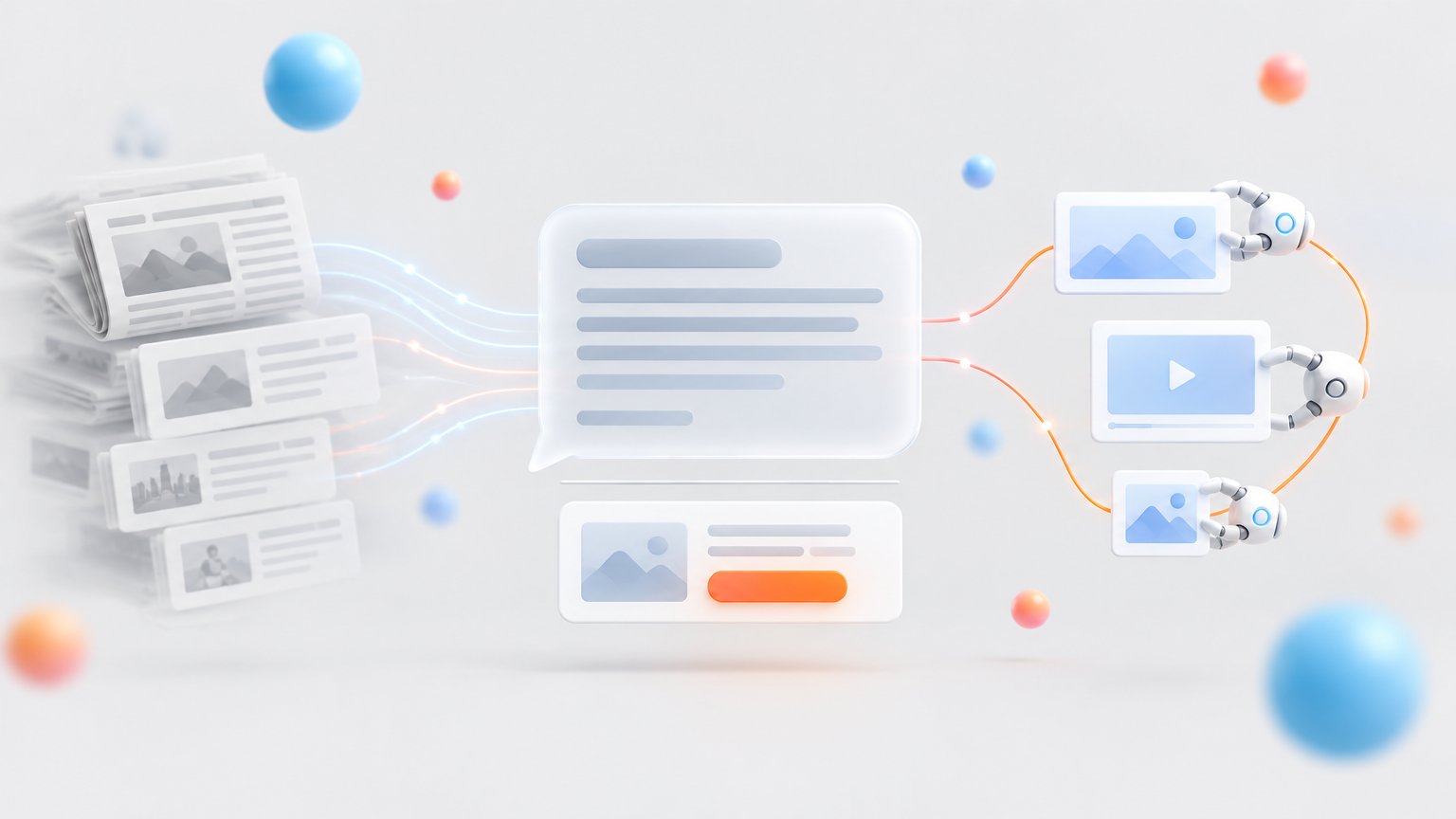
In November, IAB Switzerland brought advertisers, agencies, publishers and platforms together at DEX26, a sold-out event built around one question: who holds market power in the AI era? The line-up included OpenAI (Michelle McKelvey, Agency Lead Europe), Dentsu Germany (Markus Caspari), IAB Europe, IAB Tech Lab and Ladina Heimgartner, CEO of Ringier Medien Schweiz and President of WAN-IFRA.
The conversation was Swiss, but the same issues are reaching Portugal at the same time. Here is what the event put on the table and what it means for anyone investing in marketing in Lisbon or Zurich.
Urs Flückiger, Managing Director of IAB Switzerland, pointed out that digital advertising is particularly well suited to AI. Buying, audience targeting and parts of campaign optimisation have been automated for years. Generative AI is now moving into strategy, creative work and planning.
The new element is agentic systems: software that carries out multi-step tasks, such as comparing offers from several publishers and preparing a purchase. For advertisers, that can lower costs. For agencies, it can squeeze fees. And whoever controls the agents gains influence over what gets booked, where and at what price. The IAB left three questions open: who invests in these systems, which business models win, and who sets the selection criteria.
Standardisation is moving slowly. Early in 2026, IAB Tech Lab published a roadmap for scaling agentic buying and selling on top of the standards the industry already uses, combined with protocols such as MCP and A2A. In parallel, a group of companies launched AdCP, a competing protocol. By September, little money was flowing through either. Even so, 66% of advertisers surveyed by the IAB said they planned to focus more on agentic buying this year.
In practice, an agent buys from a brief. If that brief doesn’t spell out which contexts are brand-safe, which publishers to favour and which metrics count, those decisions pass to whoever configured the agent.
For years, search and social media sent readers to news sites, bringing ad revenue and subscriptions with them. Today an AI assistant summarises several articles in one answer and the user no longer needs to open the source. Martin Radelfinger, DEX26 programme lead, sums up the tension: journalism keeps its value for the answer, but publishers are left with fewer means to fund it.
International data points the same way. In a Pew Research Center study of 68,000 real searches, users clicked a result 8% of the time when an AI summary appeared, against 15% without one. Chartbeat data published by the Reuters Institute showed Google search traffic to publishers falling by a third globally in the twelve months to November 2025.
The responses discussed at DEX26 include source attribution, traceable usage, licensing and fair compensation.
For advertisers, this has two effects. The media they buy may lose audience that used to come from search. And the brand’s own content (articles, product pages, studies) is now read and summarised by assistants that may never send the visitor to the website.
Since 24 August 2026, businesses in Switzerland have been able to advertise in ChatGPT, and since 31 August they can set up campaigns themselves through Ads Manager. In Portugal, paint brand Robbialac, working with Social Animals, became the first brand to run ChatGPT Ads aimed at the Portuguese market. Sandra Alvarez, Executive Director of APAP (the Portuguese association of advertising agencies), called for interest without euphoria: an important launch, in her view, but not the new Google.
What to know before investing:
- Ads appear below the answer, labelled as advertising, and only for users on the Free and Go plans. Paid Plus, Pro and Enterprise plans are ad-free.
- In the European Economic Area and Switzerland, OpenAI says it is not showing personalised ads for now. The context of the conversation does the job that targeting does in other channels.
- Buying is on a CPM or CPC basis, and measurement uses the OpenAI Pixel, the Conversions API, third-party integrations and UTM parameters.
At DEX26 the topic was looked at from three angles. Whoever runs the interface decides when and in what context a brand reaches the user. Agencies have to measure what the channel adds to a campaign. And users need to be able to tell a recommendation from an ad.
Our view: treat it as a test channel, with a closed hypothesis, your own measurement from day one and a budget that can fail without doing damage. The ad should answer the question the person has just asked, because that is what puts it in front of them.
Switzerland. The IAB raised a hypothesis that matters to any small market: global platforms are better represented in the data that feeds AI models and may therefore be recommended more often than local media. Its proposal is to test this with comparable briefs. In a country with three major language regions, the test should run in German, French and Italian, because a brand that shows up well in German answers may be missing in French ones.
Portugal. The same hypothesis is worth testing here. Most Portuguese-language content online comes from Brazil, so it pays to check whether answers in European Portuguese recommend Portuguese brands, retailers and media, or lean towards Brazilian and global references. On the spend side, the Portuguese advertisers’ association APAN asked in May for a model open to smaller national advertisers too. Self-service access moves in that direction, and the Robbialac case shows Portuguese brands are already experimenting.
In both markets, with no personalised ads, the way the ad and the landing page are written carries more weight than the audience list.
The DEX26 programme describes the shift for brands well: being mentioned somewhere is no longer enough, a brand has to be taken seriously at the moment of decision. An assistant may recommend a competitor because that competitor shows better proof of experience, with cases, numbers and reviews the model can read and cite.
There’s a second, less obvious point. If AI can generate dozens of usable campaign ideas, what sets a team apart is judgement: deciding what fits the brand and owning that choice.
- Ask assistants what your customers ask. Pick 20 real questions from your category and put them to ChatGPT, Gemini, Copilot and Perplexity, in European Portuguese (and in German, French and Italian if you operate in Switzerland). Note which brands come up and with what arguments.
- Put proof where it can be cited. Case studies with results, certifications, reference prices and reviews, on public pages that are up to date and easy to read.
- Test ChatGPT Ads with a hypothesis. One product or service, a test budget, UTMs and the Conversions API live before the first impression.
- Rewrite your media briefs. Spell out brand-safety criteria, preferred publishers and the metrics that count, so an agent (or a partner) can follow them.
- Separate AI traffic in your analytics. Isolate visits from chatgpt.com, perplexity.ai, gemini.google.com and copilot.microsoft.com and track them month by month.
The central question at DEX26, who ends up holding the power, has no answer yet. There’s a smaller one every brand can answer this week: when someone asks an assistant for a recommendation in your category, does your name come up? And if it does, what does the assistant say about you? If you’d like to talk through what you find, let’s talk.